


By Dexter Boehm-North
Why STMicroelectronics offers MWG exposure to a rapidly expanding space economy through an established, diversified business
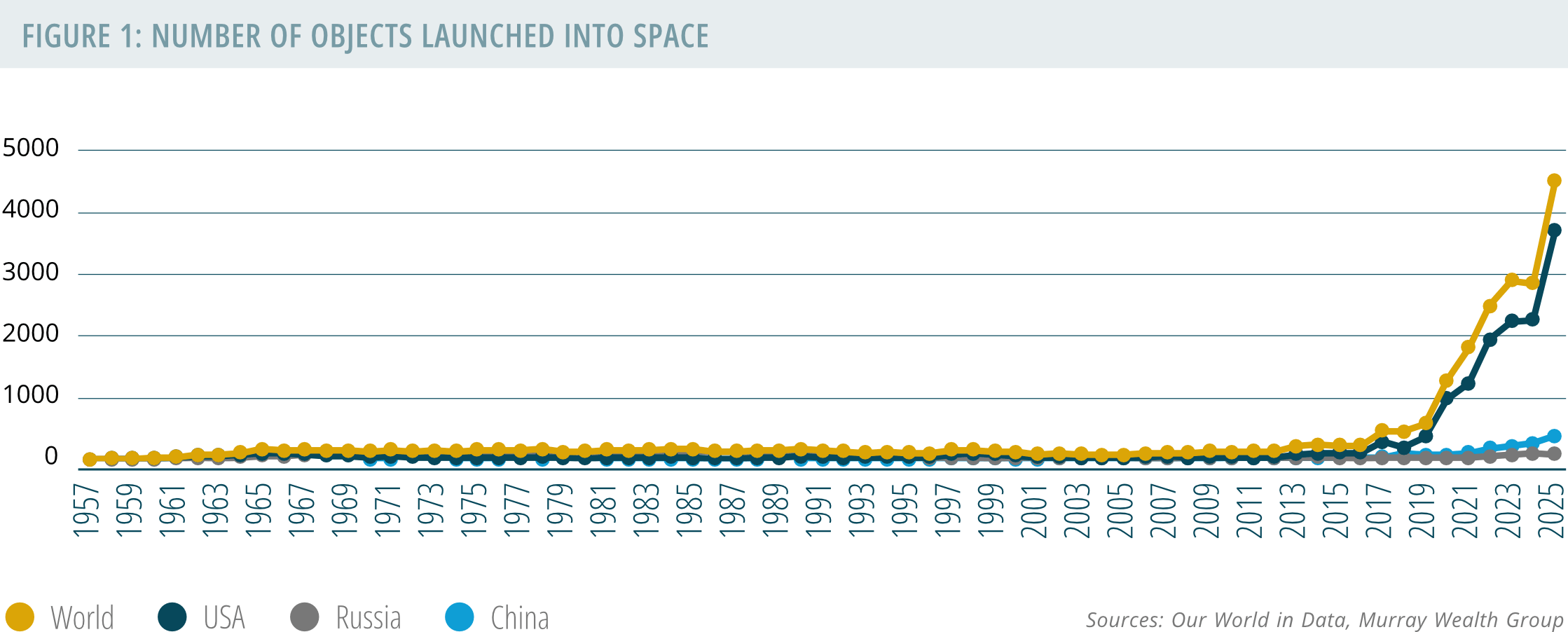
Although the SpaceX IPO has garnered a great deal of attention for the space and satellite sector, the industry had been experiencing compounding growth for many years prior. Successful orbital launches have grown at roughly 25 percent a year since 2020 (Figure 1), while the cumulative number of objects placed in orbit has more than tripled over the past decade. Recent increases in launches have also been driven largely by corporations rather than the governments that historically dominated the sector. These companies bring with them vast supply chains and client bases, introducing a new wave of exposure to the equities market.
Like many hypergrowth industries, success breeds speculation. On that note, Morgan Stanley forecasts more than $2 trillion of SpaceX’s projected market capitalization to be attributed to orbital artificial intelligence compute, a market still in its infancy. To put the magnitude of this valuation into perspective, it is almost equivalent to the entire Canadian GDP.
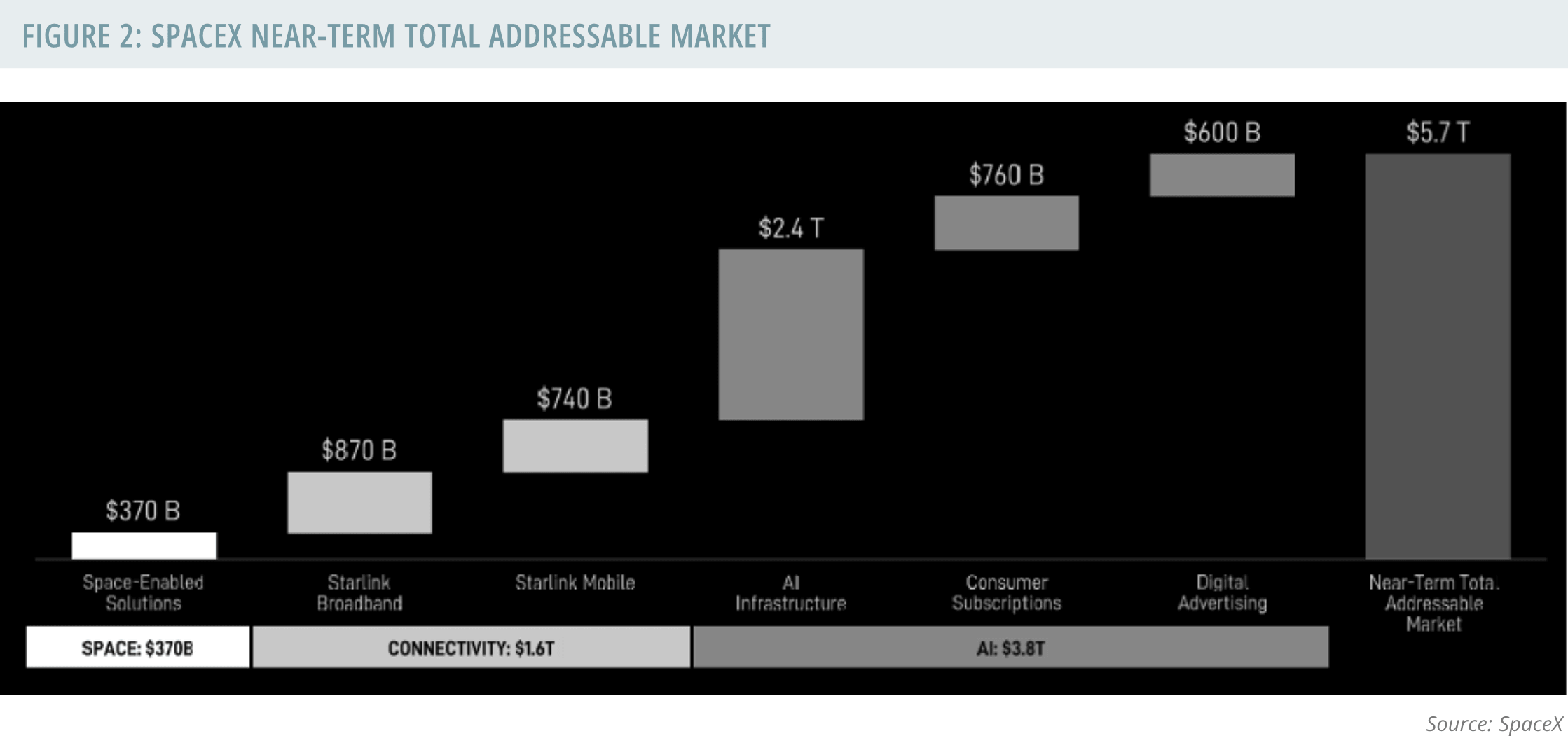
Despite the speculative nature of the sector, the current market is still evidently large, with SpaceX’s S-1 outlining a near-term Total Addressable Market (TAM) of $5.7 trillion, including $370 billion in space-enabled solutions, $2.4 trillion in AI infrastructure and $1.6 trillion in satellite-enabled connectivity.
Recent developments are comparable to a new space race, involving players from both the public and private sectors, sometimes working cohesively. Countries across the globe have been investing in innovation and organizing their own launch programs. OneWeb, the second-largest low-Earth-orbit constellation at 648 Airbus-built satellites, is now the LEO arm of France’s Eutelsat Group following a 2023 merger. After a €1.5 billion recapitalization, the French State is its largest shareholder at close to 30 percent, with the UK Government holding roughly 11 percent.
Domestically, the Canadian government has allotted C$2.14 billion to Telesat’s Lightspeed constellation, the largest space program in the country’s history, with Quebec adding a further C$400 million. As such, federally sanctioned projects have become a major factor in this industry, highlighting the importance of public-private collaboration.
The sector in its present form revolves around hardware that, unlike terrestrial equipment, cannot be serviced or upgraded once it is operating. Satellites are consumables, and the replacement cycle gets funded whether or not data centres in space ever become commercially viable. As such, while operators compete on payload ratios and shoulder the expense of significant R&D and capital expenditures, suppliers are working to keep up with demand.
These suppliers operate on consistent contracts, often with supply-chain protection clauses and multi-year lifetimes. For the top performers, the greatest limitation is capacity as they work to keep up with, and often expand, their order books. It is these companies that have found recent investor interest to be most advantageous, and whose financial prosperity is not dependent on decades-long innovation hurdles.
A new addition to the Global Equity Growth Fund is STMicroelectronics (STM), a Geneva-based semiconductor company that has supplied space programs since 1977. ST estimates it holds more than 90% share of the LEO semiconductor market in 2025. Its low-Earth-orbit revenue has grown from about US$175 million in 2021 to roughly US$1 billion this year, against a cumulative target of more than US$3 billion through 2028. It has shipped more than five billion radio-frequency antenna chips into Starlink user terminals.
Management has explicitly excluded orbital data centres from that target, so the potential upside is disclosed without being booked. Space also remains a small share of a revenue base running near US$14 billion annualized into 2026. ST carries broad exposure across diverse geographic regions and operating segments.
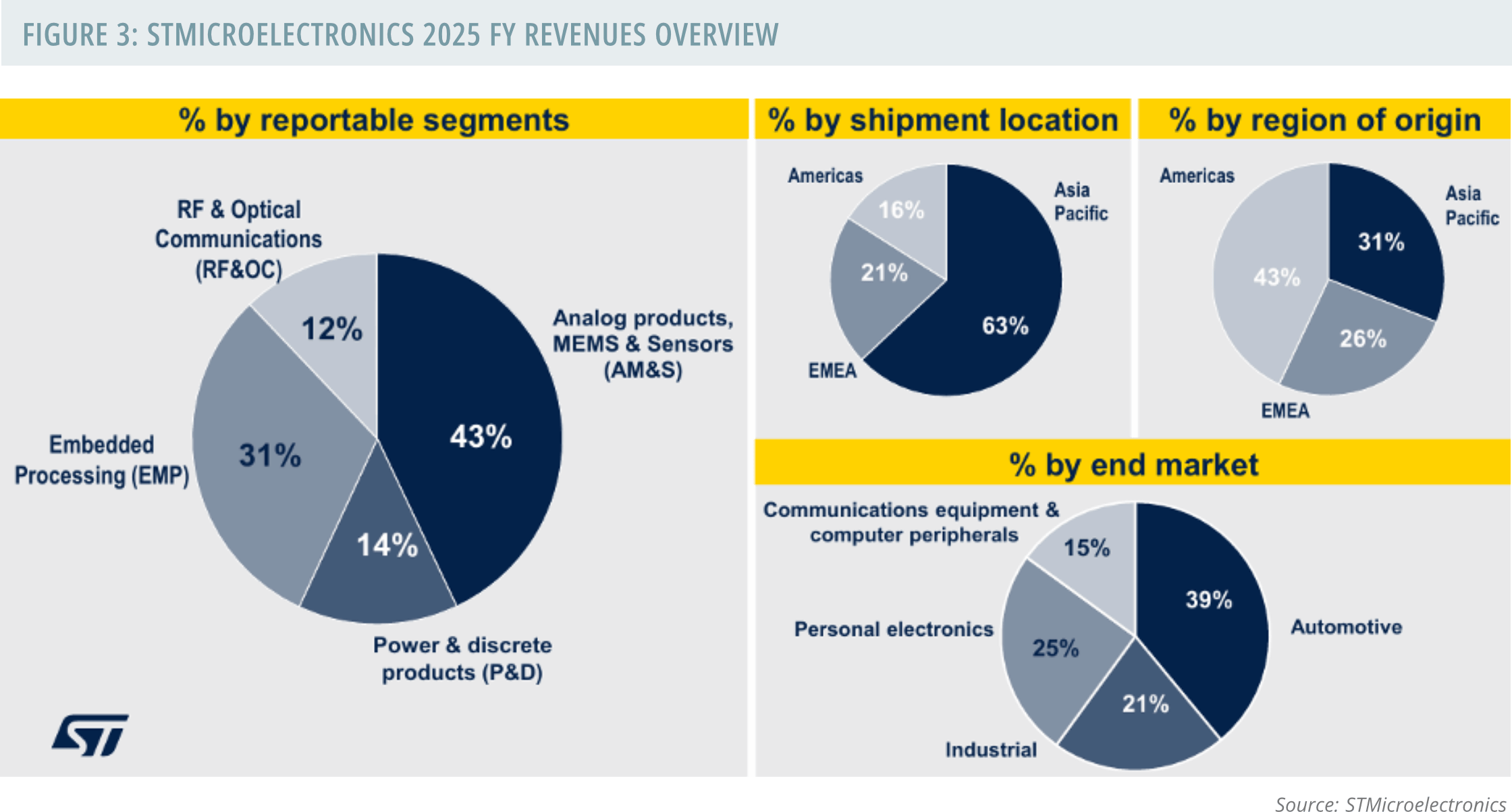
Beyond satellites, ST expects to double its datacenter business year over year in power and optical interconnects to $2B in 2027. The largest share of the company’s current revenue is attributable to the automotive sector, which his in recovery mode following a down cycle in 2024-25.. However, electric vehicle penetration is set to tick higher with EVs reaching price parity with gas-powered vehicles later this decade. Additionally, EVs are the platform of choice for autonomous vehicles, given their power architecture. However, alongside data centres and the prospect of more electronic and robotic devices coming to market, STM represents a volume-led recovery story with upside.
Regarding its space initiatives, ST’s LEO revenue is heavily tied to Starlink terminal volume. If Starlink slows terminal production or dual-sources, management’s forecasted ramp is directly exposed. Qualification cycles pose a further threat, as radiation-hardened parts require flight heritage and design-in wins that can take quarters. As a result, ST cannot respond quickly if it loses a socket.
The investment methodology at Murray Wealth Group prioritizes empirical observation over speculative forecasting. Within an industry where equity valuations frequently outpace underlying corporate fundamentals, our preference lies in securing existing, profitable revenue streams rather than pursuing theoretical market opportunities that remain subject to debate.


